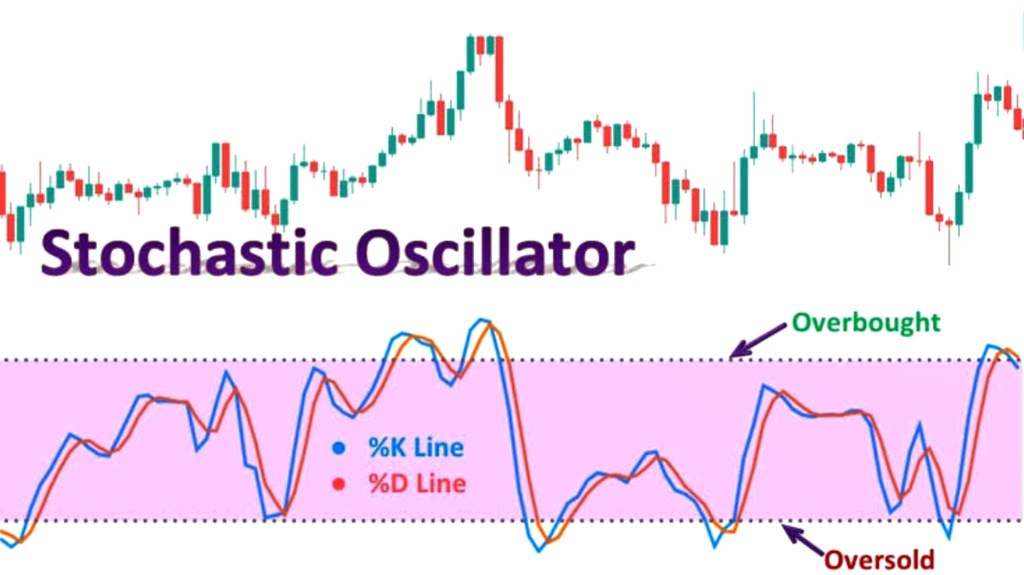
The Stochastic Oscillator is a technical indicator used to determine the momentum of price movements for a particular asset. It compares the closing price of an asset to its price range over a certain period of time, typically 14 periods.
The indicator is based on the assumption that as an asset’s price increases, its closing price tends to be near the top of its range, and as its price decreases, the closing price tends to be near the bottom of its range. The Stochastic Oscillator uses two lines, %K and %D, to measure this momentum and to identify overbought and oversold conditions.
%K is the main line of the indicator and is calculated by taking the current closing price of the asset, subtracting the lowest low over the past 14 periods, and then dividing the result by the difference between the highest high and the lowest low over the same period. %D is a smoothed version of %K and is typically calculated as a 3-period moving average of %K.
The Stochastic Oscillator ranges from 0 to 100, with readings above 80 indicating overbought conditions and readings below 20 indicating oversold conditions. Traders and investors can use the indicator to identify potential buying and selling opportunities based on these overbought and oversold conditions, as well as to confirm trends in the price movements of an asset.
For example, let’s say you are analyzing the price movements of a stock over the past month using the Stochastic Oscillator. You notice that the %K line has crossed below the %D line and both lines are below 20, indicating an oversold condition. This may suggest that the stock is undervalued and could be a potential buying opportunity. Alternatively, if the %K line has crossed above the %D line and both lines are above 80, indicating an overbought condition, this may suggest that the stock is overvalued and could be a potential selling opportunity.
The best settings for the Stochastic Oscillator depend on the particular asset being analyzed and the trading strategy being employed. The default setting of 14 periods is commonly used, but some traders may prefer to use shorter or longer timeframes depending on their trading goals and risk tolerance.
In summary, the Stochastic Oscillator is a technical indicator used in trading and investment analysis to determine the momentum of price movements for a particular asset. It uses two lines, %K and %D, to measure this momentum and to identify overbought and oversold conditions. Traders and investors can use the indicator to identify potential buying and selling opportunities and to confirm trends in the price movements of an asset.
 The Stock Stethoscope
Leave a comment