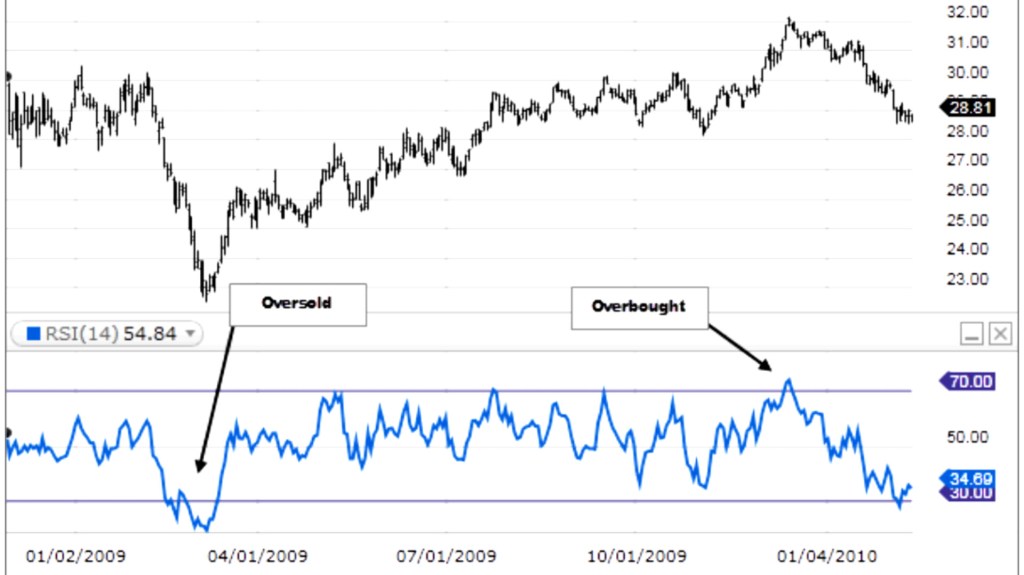
The Relative Strength Index (RSI) is a technical analysis indicator used to measure the strength of a security’s price action, by comparing the magnitude of its recent gains to its recent losses, and converting that information into an oscillator that fluctuates between 0 and 100.
RSI can be calculated over different time periods, but the most common setting is a 14-day period.
The RSI oscillator is calculated by first determining the average gain and average loss of the security over the given time period. The average gain is the sum of gains over the period divided by the number of periods, while the average loss is the sum of losses over the period divided by the number of periods.
The RSI is then calculated using the following formula:
RSI = 100 – (100 / (1 + RS))
Where RS = Average Gain / Average Loss
The resulting RSI value ranges from 0 to 100, with values above 70 typically considered overbought, and values below 30 considered oversold.
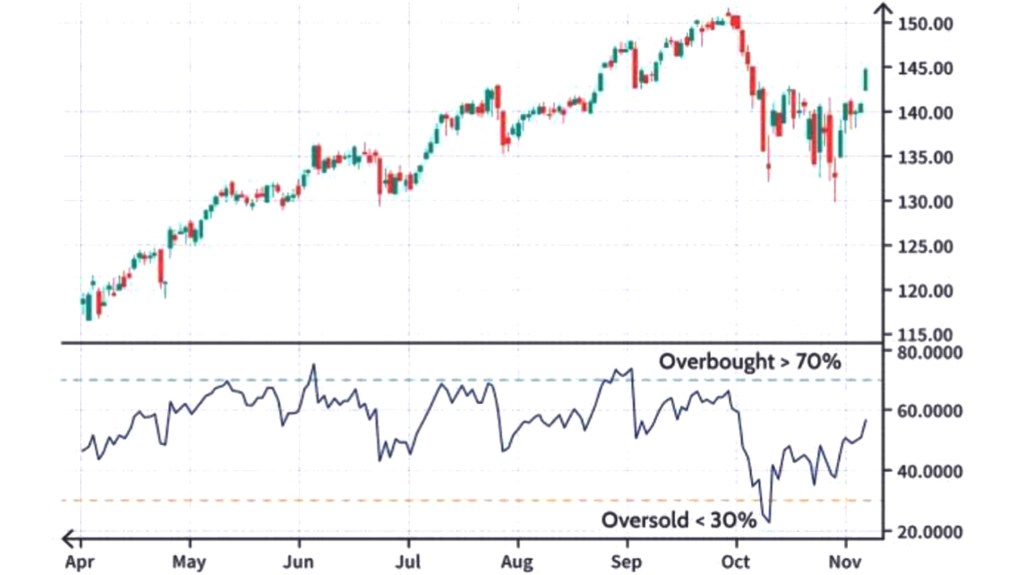
Traders use RSI to identify potential trend reversals, as well as to confirm the strength of existing trends. For example, if the RSI is indicating that a security is oversold and the price has been trending downward, this may be a signal to buy. Similarly, if the RSI is indicating that a security is overbought and the price has been trending upward, this may be a signal to sell.
As for the best settings for the indicator, it largely depends on the trader’s personal preference and trading strategy. Some traders may prefer shorter time periods for more frequent signals, while others may prefer longer time periods for more reliable signals.
RSI is often used in conjunction with other technical indicators, such as moving averages and Bollinger Bands, to confirm signals and increase the likelihood of profitable trades. For example, a trader may wait for a security to be oversold according to RSI and then confirm the signal with a bullish crossover of the 50-day moving average.
 The Stock Stethoscope
Leave a comment