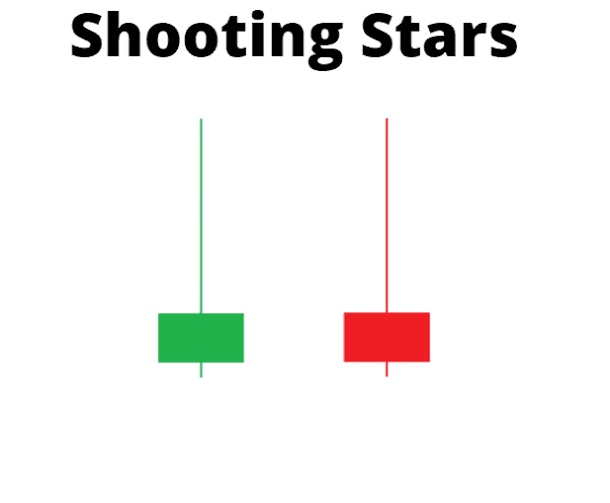
The “shooting star” is a bearish candlestick pattern that occurs during an uptrend in a financial instrument’s price. The pattern is formed by a single candle with a small body and a long upper shadow that is at least two times the length of the candle’s body. The lower shadow is usually very small or non-existent.
The pattern gets its name from the appearance of a shooting star as the long upper shadow represents the tail and the small body represents the head of the star.
Here are the key characteristics of a shooting star pattern:
It occurs in an uptrend: The shooting star pattern only forms during an uptrend, indicating a potential reversal of the trend.
It has a small body: The candle’s body is small, indicating indecision between buyers and sellers.
It has a long upper shadow: The upper shadow is at least two times the length of the candle’s body, indicating that the price rose significantly during the day, but eventually sellers pushed the price back down.
It has a small or non-existent lower shadow: The lower shadow is usually very small or non-existent, indicating that there was little to no buying pressure during the day.
It signals potential reversal: The shooting star pattern is a bearish reversal pattern, indicating that the uptrend may be coming to an end and that a downtrend may be starting.
Traders and investors use the shooting star pattern as a signal to sell or go short on the financial instrument. However, it is important to wait for confirmation from subsequent price action before taking a trade. Traders often wait for a bearish candle to form after the shooting star to confirm the reversal.
In summary, the shooting star pattern is a bearish reversal pattern that occurs during an uptrend in a financial instrument’s price. It has a small body, a long upper shadow, and a small or non-existent lower shadow. Traders use it as a signal to sell or go short on the financial instrument, but they should wait for confirmation from subsequent price action before taking a trade.
 The Stock Stethoscope
Leave a comment