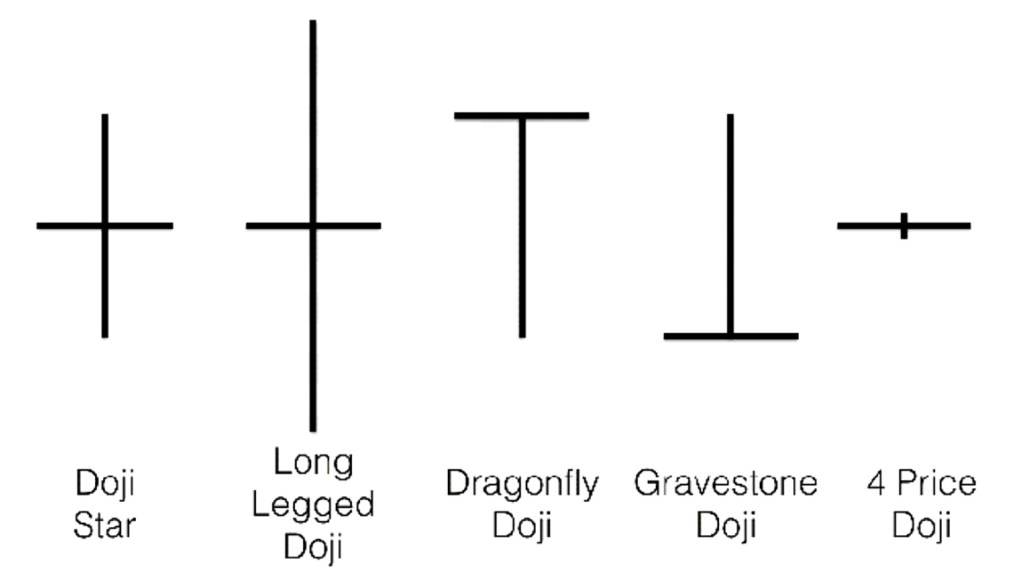
The “Doji” candlestick pattern is a commonly observed candlestick pattern on price charts and is widely used by technical analysts to interpret market sentiment. A Doji pattern occurs when the opening and closing price of an asset is almost the same, creating a short candlestick with a long wick.
A Doji candlestick pattern indicates that there is a temporary balance between buyers and sellers, and it can be seen as a sign of indecision in the market. The length of the wick represents the high and low price for the period, which suggests that the price has moved both up and down during the trading period, but it has ultimately closed near the opening price.
There are four main types of Doji candlestick patterns:
Classic Doji: This is the most basic Doji pattern, and it occurs when the opening and closing price of an asset is exactly the same. It has a small body and long wicks on both sides, indicating a balance of power between buyers and sellers.
Long-Legged Doji: This Doji pattern has a longer wick on both sides than the Classic Doji. It indicates that there was more volatility during the trading period, but the price ultimately closed near the opening price.
Dragonfly Doji: This Doji pattern occurs when the opening price and closing price are the same, but the price has moved higher during the trading period. It has a long lower wick and no upper wick, indicating that buyers have taken control.
Gravestone Doji: This Doji pattern occurs when the opening price and closing price are the same, but the price has moved lower during the trading period. It has a long upper wick and no lower wick, indicating that sellers have taken control.
The interpretation of Doji patterns can be subjective and depends on the context of the market. A single Doji may not be enough to make a trading decision, and it should be considered in conjunction with other technical analysis tools and indicators. Doji patterns can indicate a potential reversal or continuation of a trend, but traders should always be cautious and consider the risks involved in trading.
 The Stock Stethoscope
Leave a comment