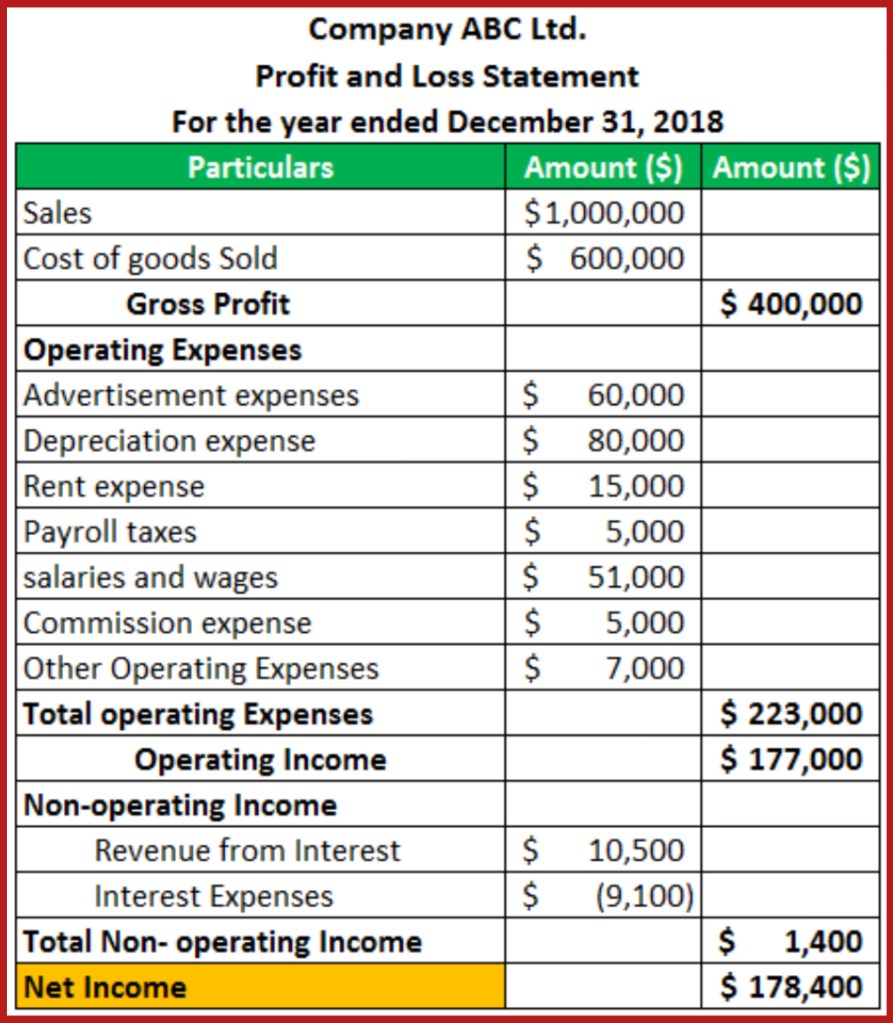
A profit and loss statement, also known as an income statement, is a financial statement that shows a company’s revenues, expenses, and net income (or loss) over a specific period of time. The purpose of the statement is to provide insight into a company’s financial performance and to help stakeholders make informed decisions.
Here are some key elements of a profit and loss statement:
Revenue:
This is the total amount of money a company earns from its operations. Revenue can come from the sale of products or services, as well as other sources such as investments or interest income.
Cost of goods sold (COGS):
This is the cost of producing or purchasing the products or services that the company sells. COGS includes the cost of raw materials, labor, and other expenses associated with production.
Gross profit:
Gross profit is the difference between revenue and COGS. This figure shows how much profit a company is making on the sale of its products or services.
Operating expenses:
These are the costs associated with running a business, such as rent, salaries, marketing expenses, and utilities. Operating expenses are subtracted from gross profit to arrive at operating income.
Operating income:
This is the profit a company makes from its regular business operations. It is calculated by subtracting operating expenses from gross profit.
Other income and expenses: These are non-operating items that can affect a company’s bottom line, such as gains or losses from investments or one-time expenses.
Net income:
Net income is the bottom line of the profit and loss statement, and it represents the company’s profit or loss for the period. It is calculated by subtracting all expenses from revenue, including both operating and non-operating expenses.
Overall, the profit and loss statement is a critical financial statement that provides valuable insights into a company’s financial performance. It is used by investors, lenders, and other stakeholders to evaluate the company’s profitability and financial health.
 The Stock Stethoscope
Leave a comment